
If your company has just launched a website in five languages using machine translation or generative AI, your leadership team is probably celebrating the cost savings and speed to market. Thousands of product pages and blog posts have been translated in record time. The problem is that, in the digital ecosystem of 2026, translating a website does not mean anyone will find it.
In fact, translating keywords literally is one of the main reasons localized pages fail to rank in search engines [1].
AI is highly effective at processing text, but it lacks local market context. When you entrust your international digital presence to an unsupervised system, you expose your business to two critical risks: a loss of organic visibility and the dilution of your brand identity in local markets.
This is where active governance becomes essential—and why conventional SEO approaches alone are no longer enough.
The Keyword Translation Trap—and Why It Destroys ROI
One of the costliest mistakes in digital internationalization is assuming that search intent transfers directly from one language or market to another.
A user in Spain may search for “ordenador portátil,” while a user in Mexico is more likely to search for “laptop.” Both speak Spanish, but their search behavior is fundamentally different [2]. If your AI simply translates your primary English keyword, “laptop,” literally for the Spanish market, you may end up competing for a term your target audience rarely uses.
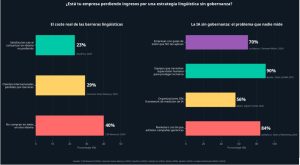
The financial impact can be substantial. Recent data indicates that 96% of B2B leaders report a positive return on investment from effective localization, while transcreation—the cultural adaptation of a message—can deliver conversion rates 40–60% higher than standard machine translation [3].
International SEO is not about translating the keywords that perform well in your home market. It is about discovering the language your prospective customers use in each target market when searching for a solution to their problem.
Visibility in the Age of Generative AI and AI Overviews
The search landscape has changed dramatically. In 2026, search engines increasingly use AI-generated summaries, including AI Overviews, to answer users’ questions directly.
What does this mean for multilingual content? A recent study analyzed 1.3 million AI-generated citations and found that websites with properly localized versions achieved up to 327% greater visibility in AI Overviews for searches conducted in those languages [2]. By contrast, websites that are unavailable in the user’s language—or that have been poorly localized—are almost invisible.
If your content is not aligned with local search intent and does not use the precise terminology expected by native users and search systems, your brand may simply not appear in AI-generated answers.
LangPresence: International SEO and Brand Governance
Companies need to stop viewing translation as a word-replacement exercise and start managing multilingual communication as a strategic operation: LangOps. This is the purpose of LangPresence.
LangPresence is not simply a website translation service. It is a comprehensive solution designed to build and protect your brand’s visibility across international markets. It operates across three core areas:
- Native keyword research: Rather than translating an existing keyword list, LangPresence investigates actual search intent in each local market. It identifies the precise terms customers use and maps them to your products and services.
- Metadata localization and technical structure: Even outstanding content remains invisible if search engines cannot interpret the architecture of your website. LangPresence helps ensure that critical technical elements—including hreflang tags, URLs, and metadata—are properly aligned with the target language and region [1].
- Global identity with local relevance: One of the greatest challenges of internationalization is sounding locally relevant without losing the company’s global identity. LangPresence integrates your brand voice and corporate glossaries into the process, helping preserve a bold, professional, or approachable tone while adapting it to the cultural expectations of each market.
Protect Your Investment. Lead the Market.
Using AI to translate content at scale without a governance layer is a recipe for digital underperformance. The result may be thousands of grammatically correct pages that attract no visitors and fail to reflect your company’s identity.
Competing in 2026 requires more than speed. It requires relevance. You need to ensure that when your ideal customer in Germany, Japan, or Brazil searches for a solution, they find your company—and that the message they encounter sounds exactly as your brand should.
Stop translating keywords. Start localizing search intent. With LangPresence, your brand does more than speak your customers’ language: it builds the visibility and local relevance needed to compete in their market.
────────────────────────────────────────────────────────────────────
References
[1] Translated (2026). SEO and Translation: Why Translated Pages Don’t Rank (and How to Fix It). https://translated.com/resources/seo-and-translation-why-translated-pages-dont-rank-and-how-to-fix-it
[2] Optimational (2026). Multilingual SEO Localisation 2026: Complete Guide. https://optimational.com/blog/complete-guide-multilingual-seo/
[3] 12AM Agency (2026). Global Growth: How to Measure ROI for International SEO in 2026. https://12amagency.com/blog/how-to-measure-roi-for-international-seo/