If you ask most CEOs and COOs of multinational companies whether they have solved their global communication challenges, the answer is usually yes. They will tell you they have just implemented a corporate LLM, integrated a machine translation API into their CMS, or that their marketing team is using ChatGPT to localize content into any language in record time.
I had conversations just like this during the Digital Enterprise Show (DES) in Málaga between June 9 and 11, where everyone I spoke with assured me they were already using AI for translation.
For the board of directors, the language problem has been checked off the to-do list. They have slashed translation costs, multiplied their speed to market, and no longer need to wait weeks to launch a campaign in five different languages.
But this sense of control is, in reality, a dangerous mirage.
The problem with AI in corporate communication is not that it translates slowly. The problem is that, without proper governance infrastructure, it is silently eroding the company’s most valuable asset: customer trust and brand consistency. And it is doing so at a speed no human team can audit.
The Speed Trap: When AI Dilutes Your Brand at Scale
The traditional narrative from translation agencies has always been the same: “English is not enough; you must translate your website because 76% of consumers prefer to buy in their native language.”
That argument worked in 2015. In 2026, companies already know this and are already translating. The current problem is much more complex.
When a company implements generative AI without a LangOps (Language Operations) layer, a phenomenon known as brand dilution occurs. By default, AI tends to generate text that is generic, flat, and corporately “safe.”
Imagine your company is a bank that has invested millions in developing an irreverent, direct, and disruptive brand voice for the Spanish market. If you use a generic AI engine to take that voice to the German or Japanese market without injecting strict rules for tone and terminology, the AI will flatten that personality. The result will be grammatically correct, but emotionally sterile text.
At scale, this means your brand sounds like a disruptive fintech in Madrid, but like a boring traditional bank in Berlin. And inconsistency comes at a price.
The ROI of Consistency (and the Cost of Chaos)
Chief Financial Officers (CFOs) typically view language management as an operational expense (OPEX) that must be minimized. This view ignores the direct impact that consistency has on the bottom line.
Recent studies on brand management show that consistent brand presentation across all channels can increase revenue by 10% to 33% [1]. This increase is not magic; it is the direct result of the trust generated when consumers recognize communication as familiar.
Global investors and customers read between the lines. When a B2B client visits your French website and sees the product named one way on the homepage, another way in the technical manual, and a third way on the support portal, the perception of quality and reliability plummets. If you cannot maintain consistency in your text, how will you maintain it in your software or service?
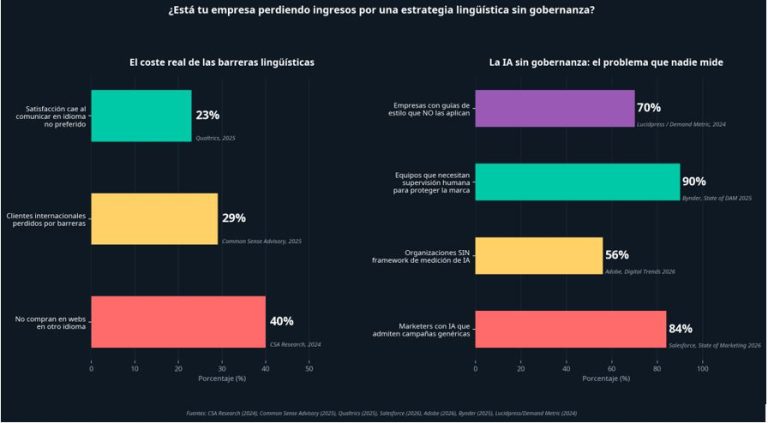
The latest data confirms this clearly. 40% of global consumers will not buy from websites that are not in their language (CSA Research, 2024), and companies lose an average of 29% of potential international customers due to language barriers (Common Sense Advisory, 2025). But the most revealing data point for the CEO who believes AI has solved everything is this: 84% of marketers already using AI admit their campaigns are generic (Salesforce, State of Marketing 2026). Speed does not equal quality.
Figure 1. Business impact of language barriers and ungoverned AI. Sources: CSA Research (2024), Common Sense Advisory (2025), Qualtrics (2025), Salesforce (2026), Adobe (2026), Bynder (2025).
The cost of this inconsistency is not reflected in the translation invoice. It is reflected in much more painful business metrics:
- Drop in conversion rates: Users abandon the sales funnel when text generates distrust.
- Surge in support tickets: AI-translated technical manuals with inconsistent terminology overwhelm customer service centers.
- Compliance risk: In regulated sectors (financial, medical, legal), a single terminological error by AI can lead to multi-million dollar lawsuits.
The Funeral of the PDF Brand Book
Historically, companies tried to solve this problem by creating a “Brand Book” or style guide: an 80-page PDF document detailing the brand’s personality, colors, and forbidden words.
In the AI era, the PDF is dead.
A static document cannot stop an LLM that is generating 500 product descriptions per minute. Marketing teams do not have the time to cross-reference every AI output with a PDF style manual. As a result, style guides end up forgotten in a shared folder while the AI publishes content that ignores them.
Language governance can no longer rely on human memory or passive documents. It must become an active system.
LangFlow: From Passive Rules to Active Governance
This is where the LangOps concept changes the game. It is not about rejecting AI, but about taming it.
For AI to generate real ROI rather than technical debt, it needs programmatic guardrails. This is exactly what LangFlow does.
LangFlow is not a style manual; it is a governance infrastructure. It works by injecting your brand voice, approved terminology, and legal constraints directly into multilingual workflows.
Instead of auditing content after the AI has generated it (when the damage is done and the cost of correction is extremely high), LangFlow acts at the generation phase. It ensures that LLMs use the brand’s voice, knowledge, and context, and respect the specific tone of each market before the text even reaches the review phase, as it is responsible for creating an optimal workflow.
Speaking the CFO’s Language
If you are the head of localization or global marketing, the next time you meet with your CEO or CFO, do not ask for a budget to “improve translation quality.” That battle is lost because, in their minds, AI already does it “good enough.”
Change the narrative. Talk to them about governance, risk mitigation, and revenue protection.
Explain that the AI investment they just made is operating blind. Show them that brand inconsistency in international markets is stifling conversion. And present LangFlow not as a language service, but as the operating system necessary to ensure the company’s voice—and its profitability—are not lost in translation.
──────────────────────────────────────────────────────────────────────
References
[1] Omnibound AI (2026). Brand Consistency Statistics: 52+ Data Points on Revenue, Trust, and AI Visibility. https://www.omnibound.ai/blog/brand-consistency-statistics
[2] CSA Research (2024). Can’t Read, Won’t Buy.
[3] Common Sense Advisory (2025). Global Customer Experience Survey.
[4] Qualtrics (2025). Language and CX Survey.
[5] Salesforce (2026). State of Marketing 2026. https://www.salesforce.com/news/stories/state-of-marketing-2026/
[6] Adobe (2026). Digital Trends Report. https://business.adobe.com/resources/digital-trends-report.html
[7] Bynder (2025). State of Digital Asset Management 2025.